


 Cart
Cart
 sales@molnova.com


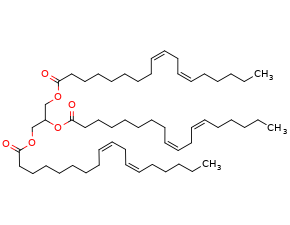
Glycerol trilinoleate
CAS No. 537-40-6
Glycerol trilinoleate( Trilinolein | 123-Trilinoleoylglycerol )
Catalog No. M20062 CAS No. 537-40-6
Glycerol trilinoleate is a triacylglycerol and has been reported to provide a number of beneficial effects including reducing thrombogenicity and arrhythmias and increasing erythrocyte deformability. It is also an antioxidant.
Purity : >98% (HPLC)
 COA
Datasheet
HNMR
HPLC
MSDS
Handing Instructions
COA
Datasheet
HNMR
HPLC
MSDS
Handing Instructions
| Size | Price / USD | Stock | Quantity |
| 5MG | 49 | In Stock |


|
| 100MG | Get Quote | In Stock |
|
| 200MG | Get Quote | In Stock |
|
| 500MG | Get Quote | In Stock |
|
| 1G | Get Quote | In Stock |
|
Biological Information
-
Product NameGlycerol trilinoleate
-
NoteResearch use only, not for human use.
-
Brief DescriptionGlycerol trilinoleate is a triacylglycerol and has been reported to provide a number of beneficial effects including reducing thrombogenicity and arrhythmias and increasing erythrocyte deformability. It is also an antioxidant.
-
DescriptionGlycerol trilinoleate is a triacylglycerol and has been reported to provide a number of beneficial effects including reducing thrombogenicity and arrhythmias and increasing erythrocyte deformability. It is also an antioxidant.
-
In Vitro——
-
In Vivo——
-
SynonymsTrilinolein | 123-Trilinoleoylglycerol
-
PathwayOthers
-
TargetAntioxidant
-
RecptorAntioxidant
-
Research AreaCardiovascular Disease
-
IndicationIschaemic heart disorders; Thrombosis
Chemical Information
-
CAS Number537-40-6
-
Formula Weight879.38
-
Molecular FormulaC57H98O6
-
Purity>98% (HPLC)
-
SolubilityDMSO:10 mM
-
SMILESCCCCC\C=C/C\C=C/CCCCCCCC(=O)OCC(COC(=O)CCCCCCC\C=C/C\C=C/CCCCC)OC(=O)CCCCCCC\C=C/C\C=C/CCCCC
-
Chemical Name——
Shipping & Storage Information
-
Storage(-20℃)
-
ShippingWith Ice Pack
-
Stability≥ 2 years
Reference
1.Clifford AJ et al. Effects of dietary triglycerides on serum and liver lipids and sterol excretion of rats. J Nutr. 1986 Jun;116(6):944-56.
molnova catalog



related products
-
?-pBrPh-Glc
?-pBrPh-Glc (?pBrPhGlc) is an inhibitor of ice recrystallization, controlling the growth of extracellular ice and inhibiting the recrystallization of intracellular ice.
-
L(+)-Tartaric acid
Tartaric acid occurs naturally in many plants particularly grapes and tamarinds and is one of the main acids found in wine. It is used as an antioxidant. Salts of tartaric acid are known as tartrates.
-
Riparin III
Riparin III (Riparin) is a smooth muscle relaxant that inhibits CaCl2-induced contractions.Riparin III has potential antioxidant, anti-inflammatory, and antidepressant properties, and may reverse the most abnormal behavioral and neurochemical changes induced by corticosterone.
